Czinger 21C Spyder Supercar Unveiled at Monterey Car Week
The American-made Czinger 21C Spyder is a road-legal, open-top hypercar that’ll see off 60mph in under two seconds – 1.9, to be exact.
It makes a frankly ridiculous 1,250bhp, only 30 are being built, and each one starts at $2.75 million (around £2.1 million). Impressive on paper, yes, but it also looks almost perfect for what it is: a fantastically exhilarating, roofless hybrid rocket.
Unveiled at Monterey Car Week in August 2026, the Spyder is the third member of the 21C family, sitting alongside the hard-top 21C HDF and the top-speed-focused 21C VMax.
So how did an already-extreme hypercar end up even wilder with less bodywork? Read on.
In case the company is new to you, Czinger Vehicles builds high-performance hypercars in California. It’s been based in Los Angeles since 2019 and was founded by Kevin Czinger (just in case you thought someone had dreamed up an almost-too-perfect name for the job) and his son Lukas, now CEO, who looks after the operational and engineering side of things.

Czinger 21C Spyder key specs
| Czinger 21C Spyder | key specs |
|---|---|
| Power | 1,250bhp (2.9-litre twin-turbo V8 plus three electric motors) |
| Engine | Twin-turbocharged 2.9-litre mid-mounted V8, 11,000rpm redline (750bhp on its own) |
| 0–60mph | 1.9 seconds |
| Top speed | 205mph (roof fitted) |
| Downforce | 1,482kg at 150mph, roof off, a claimed world record for an open-top road car |
| Price | From $2.75 million (around £2.1 million), before options |
| Production | 30 examples, hand-built in Los Angeles |
Fighter-jet Seating: the Czinger 21C Spyder Cockpit
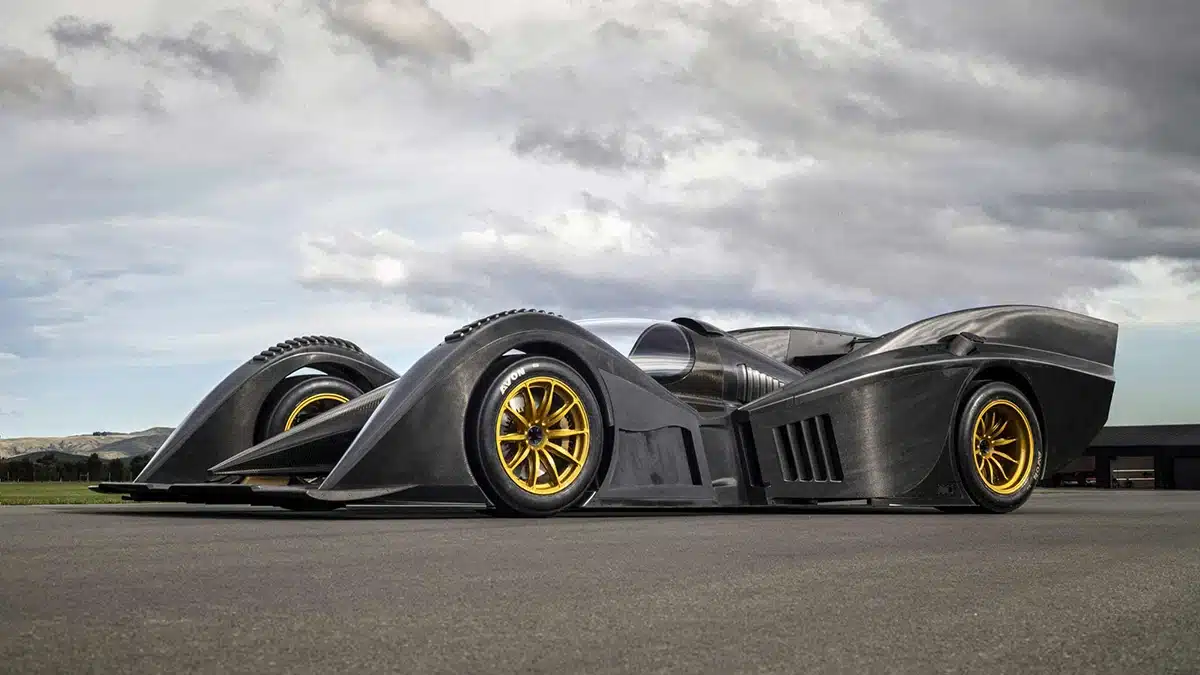
The 21C Spyder has a genuinely unusual layout: a tandem seating arrangement with the driving console central to the car and a passenger sitting directly behind, ominously like a jet fighter. It isn’t just for show, either. That narrow, inline arrangement keeps the frontal area tiny, which helps the aero and frees up room for the full-length side splitters you simply couldn’t package around a normal side-by-side cabin.
And the figures back up the theatre. The Spyder reaches 60mph in just 1.9 seconds, tops out at 205mph and serves up 1,250bhp. The bulk of that comes from a twin-turbo 2.9-litre mid-mounted V8, good for 750bhp on its own and screaming all the way to 11,000rpm, paired with three electric motors: two on the front axle handling the torque-vectoring, and a third bolted to the crankshaft.

Roof Off, Downforce (Mostly) Intact
The coupé came first, but Czinger planned for open air from the very start, which is why turning the 21C into the Spyder was more about freeing the roof than re-engineering the car around it.
The one catch: you’ll need to leave the hard-top at home to enjoy all that power rushing through your hair, though Czinger throws in a stowable fabric roof to get you home reasonably dry when the weather turns.
Lose the lid and yes, the downforce drops – but barely. The open-top Spyder still generates 1,482kg of it at 150mph, which Czinger reckons is a world record for a road-legal open-top car. Bolt the removable panel back on and that figure creeps up to match the hard-top HDF. The V8 and its 750bhp are unchanged; the rest, as ever, comes from the electric side.
NeuralNode: the Cockpit That Isn’t a Dashboard
Here’s a party trick the earlier cars didn’t have. Where you’d normally find a dashboard, the Spyder gets NeuralNode: a single 3D-printed structure that folds the instrument panel, air vents, climate controls and the steering-wheel mount into one lightweight piece, with airflow moving through the structure itself. It’s a world-first, it’s standard on the Spyder, and handily, it can be retrofitted to earlier 21Cs.
In practice that means the start button, climate controls and drive modes all sit within easy reach on either side of the slightly rectangular wheel, where a set of very tactile paddles live. There’s not a vast amount of room in here, but everything fits and sits organically, which is rather the point.

BrakeNode: Stopping the Beast
Czinger is especially proud of its other world-first: a braking system called BrakeNode. Rather than bolting a caliper to a separate suspension upright and running hydraulic lines all over the place, it consolidates the caliper, upright and fluid passages into a single 3D-printed component. The upshot is up to 15% shorter stopping distances, around 1.5lb less unsprung weight at each corner, and because there’s simply less of it, a system that’s easier to service too.
Let’s face it: when you’re driving something like the 21C Spyder, anything that helps tame the beast into stopping when and where you want it to has to be a very good thing. And like NeuralNode, it can be retrofitted to the HDF and VMax, so existing owners aren’t left out.
BioLogic: 3D Design From the Chassis Up

There’s comparatively little space for the internals of the 21C, yet everything appears to fit and sit organically, and that’s largely down to Czinger’s 3D-design know-how, developed with its parent company, Divergent Technologies (the same outfit whose process supplies components for the McLaren W1).
Czinger describes the chassis as BioLogic: an approach that treats the car as one optimised system rather than a box of separate parts. From the chassis up, everything just fits – which is exactly what lets clever tech like BrakeNode work as neatly as it does.
Every Spyder is hand-assembled at Area 21, Czinger’s Los Angeles facility, and homologated for all 50 US states, including California’s notoriously fiddly CARB certification, which Czinger cheerfully calls the hardest process going for a car at this performance level.

How Much, and How Many?
Czinger will build just 30 examples of the 21C Spyder, with prices starting at around $2.75 million (roughly £2.1 million). And at that money, it won’t surprise you to learn that Czinger will let you customise your car extensively, right down to the colour of individual 3D-printed components, at further cost, of course.

Czinger 21C Spyder: Your Questions Answered
How much is the Czinger 21C Spyder?
It starts at $2.75 million (around £2.1 million) before options, and just 30 will be built.
How fast is the Czinger 21C Spyder?
0–60mph takes 1.9 seconds, and top speed is 205mph with the roof fitted.
How powerful is it?
1,250bhp from a 2.9-litre twin-turbo V8 (750bhp on its own, revving to 11,000rpm) working with three electric motors.
What is BrakeNode?
A world-first braking system that combines the caliper, suspension upright and hydraulic passages into a single 3D-printed part, cutting stopping distances by up to 15%.
What is NeuralNode?
A 3D-printed cockpit structure that folds the dashboard, air vents, climate controls and steering-wheel mount into one lightweight piece – another world-first, standard on the Spyder.
How many Czinger 21C Spyders will be made?
Thirty, each hand-built at Czinger’s Area 21 facility in Los Angeles.
Images: czinger.com
Like What You’ve Read?
For more articles like this, receive our weekly e-newsletter, including partner deals and all things motoring, register your email below.
Please note: You cannot subscribe to Smart-Motoring unless you put a tick in the checkbox below to indicate have read and agreed to our privacy policy.